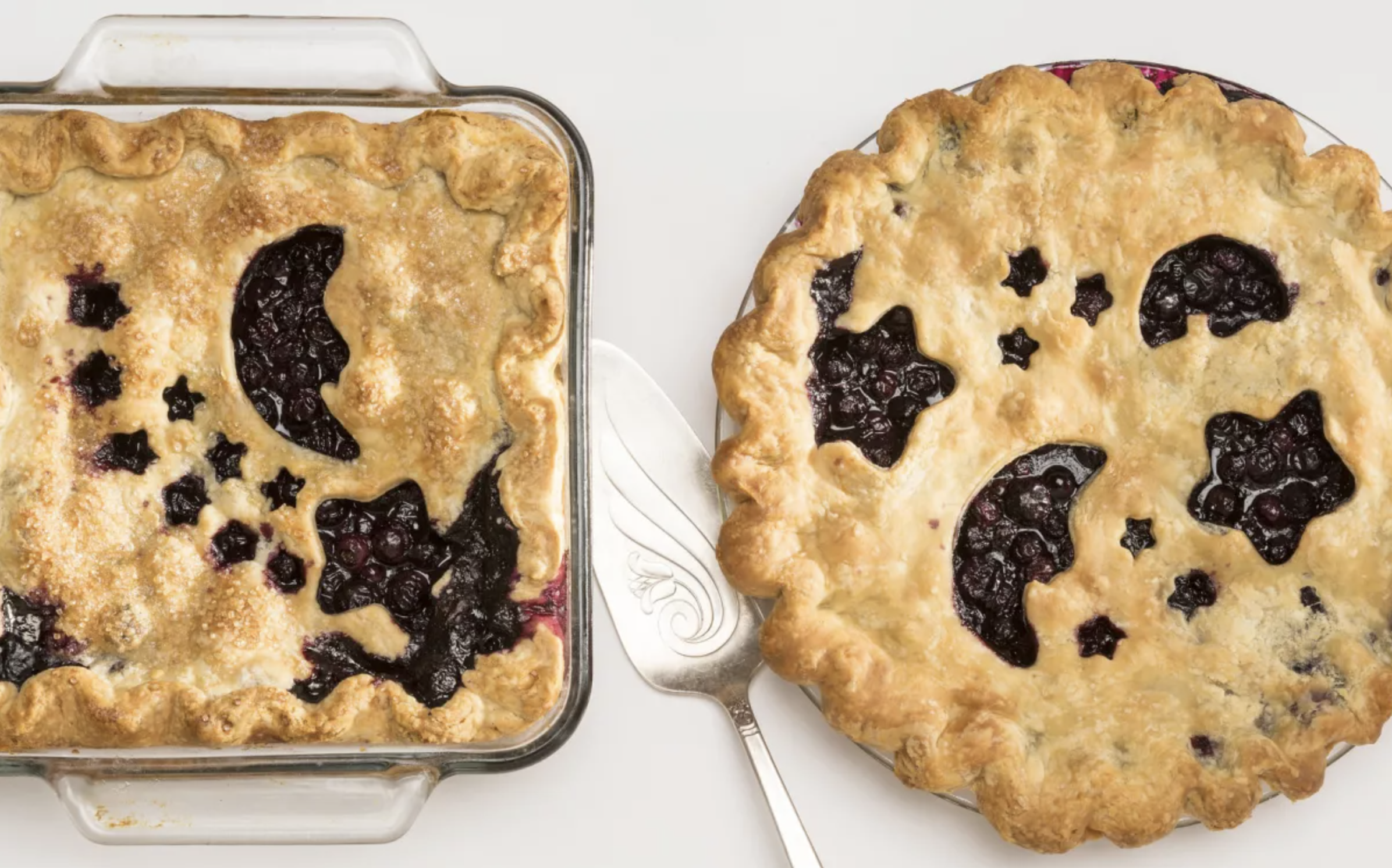
Blueberry Night Sky Pie
Preparation Time: 1 hour 20 minutes
Makes: 1 (9-inch round or 8-inch square) pie
Source: Los Angeles Times
Ingredients
Pie Crust
- 3 scant cups (12 ounces) all-purpose flour
- 1 teaspoon salt
- 2 tablespoons sugar
- About 1 cup (8 ounces) fat, such as butter, lard or shortening, or a combination
- ½ cup (4 ounces) ice cold water or fruit juice (apple, white grape, pear), more if needed
- 1 tablespoon apple cider vinegar
Pie Filling
- 4 to 5 cups fresh blueberries well washed, picked over to remove stems
- ½ cup sugar, more if desired
- ½ teaspoon kosher salt
- 1 tablespoon or a squeeze of fresh lemon juice, if desired
- 1 teaspoon cinnamon
- 2 to 3 tablespoons cornstarch
- Egg wash (beaten egg, or egg beaten with cream), if desired
- Sanding or turbinado sugar for dusting, if desired
Description
We come from everywhere in the world, but when we take our fork to a triangular piece of barely thickened fruit, sitting in a buttery flaky crust cut out of a round whole pie, we are participating in a happy group ritual. For me, a round pie with a robust, not-too-thin crust has the golden ratio of flaky buttery goodness to just-sweet-enough thickened fruit. It is the Ur-pie, the pie meant to be sliced and served with a cup of nonartisanal, maybe even percolated coffee.
Instructions
Pie Crust
- In a large bowl, whisk together the flour, salt and sugar. Cut the fat into tablespoon-sized pieces and add them to the flour mixture. Toss the fat lumps around until they are coated with flour, then use a pastry cutter or your fingers to combine the fat with the flour until the fat is reduced to uneven crumbles, some as large as an almond and others as small as peas. Drizzle over the water and vinegar, and gently stir until the mass comes together (if using a high-fat butter, you might need up to 5 ounces of water). Don’t worry if the dough is a little shaggy; it’s all right as long as it sticks together.
- Dump the mixture out onto your work surface. Use a bench scraper to gather the crumbs into the mass of dough. Use the heel of your hand to smear the dough away from you a third at a time. You are creating flat layers of flour and butter. After the dough is smeared out gather it back together with the bench scraper, using the scraper to layer the smears on top of each other, creating a mass of dough. Do it again. The dough should come together nicely, but you should still see pieces of butter.
- Divide the dough in half and form into flat disks. Wrap each in plastic wrap and refrigerate until well-chilled, at least an hour and up to two days. You can also freeze the dough for up to 1 month.
Pie Filling
- Heat the oven to 425 degrees.
- On a lightly floured surface, roll out one of the disks of dough until it is about 2 inches larger in diameter than the baking plate. Fit the dough into the plate and refrigerate. (If the dough is very firm, whack it a few times with the rolling pin to soften so the dough is easier to roll.) Roll out the second disk to make a top crust that is slightly larger than the diameter than the top of the pie plate. Cut out star and moon shapes from the top crust, saving the cutouts for decoration. (If you want to decorate the top with just cutouts, instead of a lattice, cut out more shapes as desired.) Refrigerate the top crust and cutouts.
- In a large bowl, toss together blueberries, sugar, salt, lemon juice and cinnamon. Taste the mixture. If you think the berries need more sugar. add 1 tablespoon at a time, tasting after each addition until they taste good to you. Add the cornstarch to the seasoned berries and toss well.
- Remove dough-lined pie plate from the refrigerator and fill with the berries, spreading so the berries evenly fill the pan.
- Cover the pie: Remove the top crust and/or cutouts from the refrigerator and fit over the prepared pie. Crimp the top crust with the bottom crust if using. If desired, brush the top of the pie with egg wash, and sprinkle over sugar.
- Put the pie on the lowest rack of oven and cook for 20 minutes. After 20 minutes, move pie to a rack in the middle of the oven and reduce the heat to 375 degrees. Keep an eye on the pie; if it begins to brown too quickly, loosely tent with foil.
- Continue to bake until the crust is a deep golden color and the filling is bubbling throughout and the juices have thickened, about 25 minutes more. Carefully remove and cool on a rack until ready to serve. The filling will continue to thicken as the pie cools.
Recipe Websites
Better Homes and Gardens
Better Homes and Gardens is a great example of a recipe website with a clear and simple hierarchy. Each new section of the recipe is clearly indicated with a heading using a large serif typeface, contrasting the sans-serif typeface used for the recipe content and smaller headings. Additionally, it uses subtle colors and shapes to indicate important information about the recipe.
Food Newtork
Food Network's website does a good job of using color to unify the different elements on the page. The red color is first introduced in the logo at the top of the page and is reused in the 5-star rating system, the "Save Recipe" button, and the checkmarks in the ingredients list. This website also used a two-column layout, making it easier to refer to the ingredients list and the instructions without scrolling up and down the page.
Padma Lakshmi
Padma Lakshmi takes a more simple approach to webpage design for her recipes. While the ingredients and instructions are each organized into lists, numbers and bullet points are not used, giving the lists a clean, minimalist look. While visually pleasing, this approach sacrifices some of the recipe's usability, making it more difficult to follow and refer back to while cooking.
Non-Recipe Websites
The Public Theater
The Public Theater's website has a very strong cohesion with its imagery. Most of the images on the homepage use the same visual system, utilizing a bold expressive typeface placed over colorful shapes. The site also makes great use of hover animations to help guide the user through the page and to provide more information.
Groundwork Coffee
Groundwork Coffee's homepage contains a lot of content that the user experiences through a vertical scroll. In order to make the quantity of information less overwhelming, the page is broken up using different colored backgrounds to differentiate between sections. In addition, each section is indicated with a vertical label on the left side of the page.
Grand Central Market
The website for Los Angeles' Grand Central Market does a good job of using the market's natural visual interest to inform the design of the website. The large images at the top of the homepage use the market's eye-catching neon signage to grab the attention of the user. Further down the page, colorful photos of food and vendors take up most of the space on the page. Because of the bright colors in these images, the rest of the website's design uses mostly white and black to balance out the content on the page, only using color sparingly.